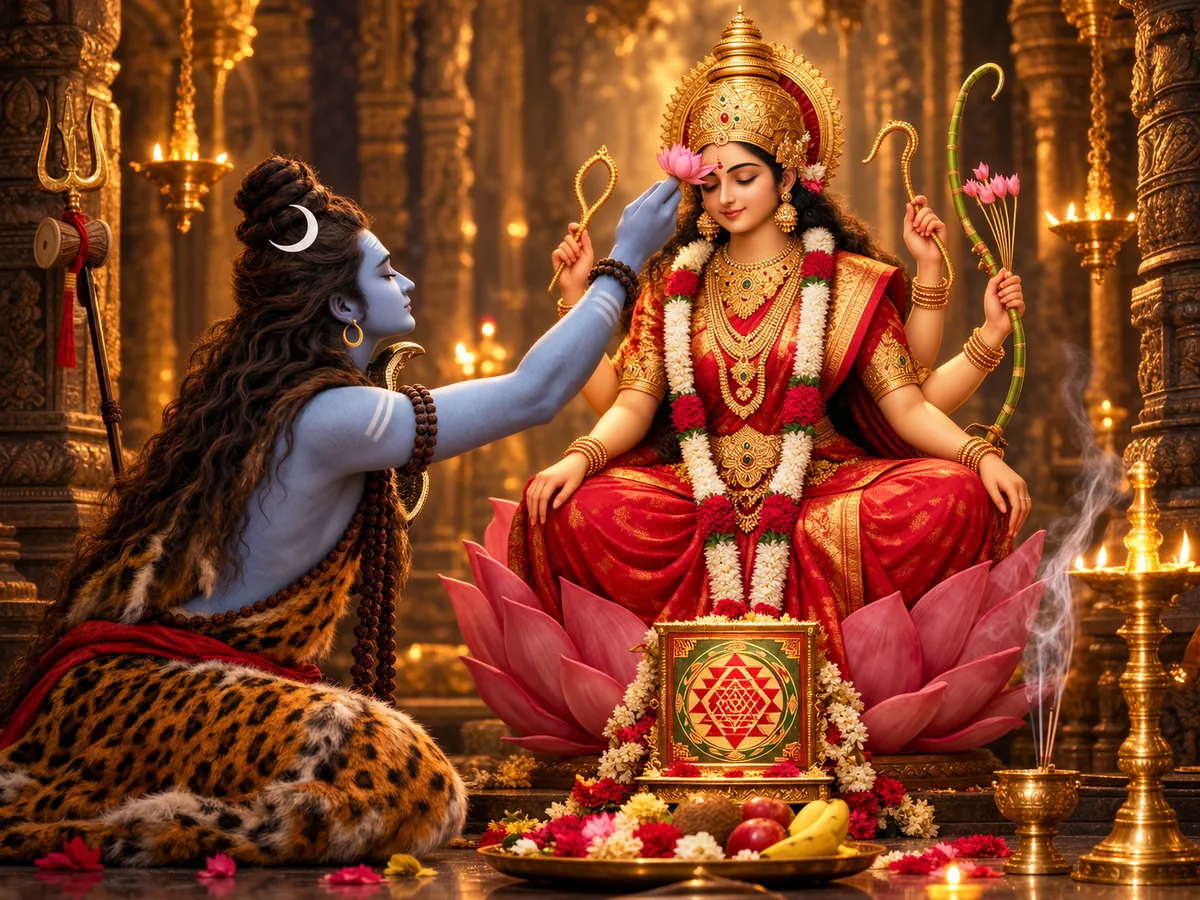
Kaula tantra is a Goddess centred tantric path. Kaula comes from kula, which means family. It teaches that everything belongs to one family under the Divine Mother, and that freedom can be found inside ordinary life. It is passed from teacher to student and practiced through mantra, ritual, meditation and a guru’s guidance.
What Kaula tantra means
Kaula comes from kula. Kula means family, clan, a group that belongs together. The family in Kaula is bigger than blood. It is you, the people near you, your teacher, the whole world, and the one Divine Mother who is the head of all of it.
That is the big idea. You are not separate from her. Feeling separate is what causes the struggle, and Kaula says the way out is to find that you were never apart.
Kaula is usually described as a path for people living ordinary lives, not only for people who leave everything behind. Your work, your family, your senses and your wanting can all be part of it. The freedom is meant to happen inside your life.
You will also see it written as Kaula achara, Kaulachara or Kulachara. These are names for the same path.
Where it came from
Nobody can give you a clean founding date, and I would not trust anyone who does. Many scholars think Kaula grew out of an older cremation ground asceticism and was adapted so that people with families could follow it. Some accounts credit the teacher Matsyendranath, around the tenth century. Other scholars say that story rests on a misreading, so I hold it loosely.
What is clearer is the Kashmir chapter. The Kashmir Shaiva teacher Abhinavagupta gave Kaula much of its philosophy in his big work, the Tantraloka, and Kashmir Shaivism is also credited with softening some of its harsher practices for householders.
A lot of the tradition was never written down at all. It moved by mouth, from teacher to student. That is why the guru matters more here than any book.
Back to contentsThe core ideas
One consciousness
Everything is one awareness. Shiva and Shakti are not two things. They are one reality seen two ways.
The world is real
The world is Shakti showing herself, not an illusion. So freedom does not mean throwing away enjoyment.
Impurity is ignorance
The body and the senses are not dirty. What binds you is not knowing who you are.
Freedom is your nature
Freedom, svatantrya, is not something you earn. It is what consciousness already is.
The guru is the path
The teacher is not a side detail. In Kaula the guru is how the whole thing is passed on.
Worship goes inward
Ritual is meant to move inside, until the body itself is the temple.
The four streams
Kaula is not one single school. Scholars usually describe four main streams, called transmissions, each with its own goddess and texts. Different books count them in slightly different ways, but the common picture looks like this.
- East, Trika. Tied to Abhinavagupta and Kashmir Shaivism.
- North, Krama and Kali. Currents centred on forms of Kali.
- West, Kubjika. Linked with kundalini and the chakra system.
- South, Sri Vidya. Centred on Lalita Tripurasundari, the Goddess of the Sri Yantra.
Sri Vidya Kaula and Devipuram
I practice in the southern stream. Sri Vidya is centred on Lalita Tripurasundari. My lineage is the Sri Vidya Kaula tradition of Devipuram, in the tradition of Sri Annapurnamba sahita Sri Amritananda Natha Saraswati. Guruji was a nuclear physicist before he became a teacher. Guru Amma Annapurnamba teaches today.
One of the core practices of this stream is the Navavarana Pooja, the nine fold worship of the Sri Chakra.
This site is an independent practitioner’s space and does not speak for Devipuram. If you want to go deeper, start here:
Back to contentsHow practice works
I keep this part high level on purpose. Some parts of Kaula are kept inside the lineage and are taught person to person, not in public. I will not write them here.
Guru. It starts with a teacher, because the path is passed on, not found in a book.
Mantra. Sound repeated with attention. The old texts treat the letters of the alphabet themselves as seed sounds.
Yantra. A sacred diagram, like the Sri Yantra, used as a place to rest your attention.
Inner worship. Ritual that moves inward. Even the fire offering is mainly an inner act. This is where the idea of the body as a temple comes in.
Freedom. The result is not a special experience. It is the plain knowing that you were never separate.
Meditation and kundalini work sit alongside all of this. I offer guided techniques by private chat. You can read more on the Kundalini Awakening Meditation page.
Back to contentsWhat people find objectionable, and how Guruji answered
This is the part that makes people nervous, so I want to be straight about it. Guruji answered these questions himself in his Kaula Achara Q&A. What follows is in my own words, and I keep the details high level on purpose.
The five Ms
Kula pujas use five things that all start with the letter M in Sanskrit, so they are called the Pancha Makaras. Most people take part in ordinary versions of these things in daily life. What they object to is bringing them into worship. Guruji’s point was that everyday things also have a spiritual side, and that the objection is really about mixing the ordinary with the sacred.
He said some Kaulas follow the ordinary meanings and vegetarian Kaulas follow the inner meanings. On this site I only write about the inner ones.
| The M | Its inner meaning |
|---|---|
| Madya | Being so lost in devotion that you know nothing but the Goddess. |
| Matsya | Attention on the in breath, which moves like a fish in the waters of life. |
| Mamsa | A yogic point of focus in the mouth. |
| Mudra | Nature as your partner, who brings both pleasure and pain. |
| Maithuna | Every contact with your own nature, inside you or in the world. |
Animals
People also ask about animals being killed in worship. Guruji said needless killing has to be objected to. The goals of the path are truth, non violence and not coveting what belongs to others. If you are vegetarian, stay that way. If you are not, try to reduce harm.
Other old rites
Some old rites use things that most people find hard to accept. Guruji gave his reasons for defending them, and where he stands is clear: the path is about truth and non violence, and needless violence is wrong. I do not write about those rites on this site, and none of them are part of anything I offer.
What a puja is actually like
Guruji said the pujas offered to the public at Devipuram are satvic, which means they empower people and hurt no one. They are for willing, consenting adults, and no priest forces anyone into any puja. It begins by asking permission. Then mantras are invoked at the energy centres from the base to the crown. After that there is a ritual head bath with mantras, initiatory mantras, and an offering of flowers and kumkum. At Devipuram the recipient is clothed and the puja is done in public.
Desire
The usual spiritual way is to rise above desire. Guruji explained that the tantric way treats desire as the driving force of practice. You take your desires to Devi openly. Some get fulfilled, and your love for her grows. Some turn out to be fake, a cover for a deeper desire, and you find the real one. He also said that without practice, desire is the cause of suffering.
Back to contentsWhat Kaula is not
- It is not only about sex. Because Kaula does not call desire shameful, it often gets reduced to that online. The teaching is much bigger: consciousness, the Goddess, the guru, ritual and meditation. Guruji put the heart of tantra simply: desire becomes fuel for practice instead of something you push down.
- It is not black magic. A few old dictionary entries link the word Kaula with necromancy and black magic. That is a stigma, not the path. Guruji spoke to this in his Q&A, and said Kaula was long dismissed as a path for low caste people.
- It is not power over other people. Nothing in it is about controlling anyone.
- It is not as dangerous or forbidden as the video titles say. Those words get clicks. The old Kularnava Tantra does ask for care. It warns against undisciplined practice and tests the student first. That is a reason to go slowly with a teacher, not a reason for fear.
- It is not medical care. If you are struggling with your health or your mind, please see a doctor or therapist as well.
How it found me
I did not come to this through a book. I came through a bad stretch. I had panic attacks, and there were days I could not catch my breath. Some days it felt like being shut inside a coffin, scratching at the lid.
Then one day I closed my eyes and my ears and just sat with my breath. I heard my own heartbeat, really heard it. Under it there was a sound, like a volcano erupting inside my chest. A wheel, turning and vibrating, right there in my heart.
I had no word for it. It took years, a few teachers who came and went, and finally a path with real guidance, the Sri Vidya Kaula tradition of Devipuram, before I understood that it was kundalini. Something in me had started long before I had a name for it.
That is why I say the body is the temple, and why I keep this practical. If you are in a hard place right now, please talk to a doctor or someone you trust too. A path like this works best next to real care, not instead of it.
Back to contentsTexts worth knowing
- Kularnava Tantra. The Ocean of Kula, a conversation where Shiva teaches Devi. Thought to be from roughly 1000 to 1400 CE. It makes the guru essential, and says freedom does not mean rejecting the world.
- Tantraloka. Abhinavagupta’s big work, with chapters on the Kula ritual. It is the main source for the Kashmir side of Kaula.
- Vijnana Bhairava, Spanda Karikas and the Shiva Sutras. Short Kashmir texts that carry the philosophy.
- Guruji’s writing. His blog has a clear Q&A, Kaula Achara, and we keep a selection on the teachings page.
Reading a text is not the same as practice. Use them to understand, and use a teacher to practice.
Back to contentsWho it is for and how to begin
Guruji taught that Kaula is open to people of any gender, caste, age or stage of life. What matters is that you come willingly, and as an adult.
You do not have to leave your job, your family or your senses behind. You can start small:
- Read the piece on moksha and the piece on the body as a temple.
- Try the short daily practice in When you have no energy left.
- Or just talk to me. It is all by private chat, one to one, with no calls and no pressure.
Questions people ask
Where did Kaula tantra come from?
Nobody can give a clean founding date. Many scholars think Kaula grew out of an older cremation ground asceticism and was adapted so that people with families could follow it. Kashmir Shaivism later gave it much of its philosophy.
Is Kaula tantra the same as the left hand path?
Not exactly. Some dictionaries describe Kaula as the left hand path of Shakti worship. Guruji taught that Kaula brings the right hand and left hand paths together.
Is Kaula tantra dangerous?
Anything done without care can hurt. The old Kularnava Tantra warns against undisciplined practice and asks the student to prove their faith and patience first. That is why I work by private chat, one to one, with adults only. This is a spiritual path, not medical care.
What is the Kularnava Tantra?
It is a Kaula text whose name means Ocean of Kula. It is a conversation in which Shiva teaches Devi, and it is thought to date from roughly 1000 to 1400 CE. It treats the guru as essential and says freedom does not require rejecting the world.
How is Kaula different from Kashmir Shaivism?
They overlap a lot. Kashmir Shaivism supplied the philosophy, especially through Abhinavagupta's Tantraloka, and softened some of Kaula's harsher practices for householders. Kaula is the practice side, with ritual, mantra and a teacher.
What do people find objectionable about Kaula?
Mostly two things. One is the five Ms used in Kula pujas, because they look like ordinary worldly acts brought into worship. The other is a few old rites that most people find hard to accept. Guruji took these on directly. His view was that the path is about truth and non violence, and that needless violence is wrong.
What are the five Ms in Kaula?
They are five things that all start with M in Sanskrit, called the Pancha Makaras: Madya, Matsya, Mamsa, Mudra and Maithuna. Guruji gave their inner meanings. Madya is being lost in devotion, matsya is attention on the in breath, mamsa is a yogic point of focus in the mouth, mudra is nature as your partner who brings pleasure and pain, and maithuna is every contact with your own nature, inside or in the world. On this site I only write about the inner meanings.
Does Kaula involve killing animals?
Guruji said needless killing is wrong. The goals of the path are truth, non violence and not coveting what belongs to others. If you are vegetarian, stay that way. If you are not, try to reduce harm.
What happens in a Kaula puja at Devipuram?
Guruji said the pujas offered to the public are satvic, which means they empower people and hurt no one. They are for willing, consenting adults, and no priest forces anyone into any puja. It begins by asking permission, then mantras are invoked at the energy centres from the base to the crown, followed by a ritual head bath with mantras, initiatory mantras and an offering of flowers and kumkum. At Devipuram the recipient is clothed and the puja is done in public.
Is desire bad in tantra?
No. The usual spiritual way is to rise above desire. The tantric way, as Guruji explained it, treats desire as the driving force of practice. You take your desires to Devi openly. Some get fulfilled, and some turn out to be fake, a cover for a deeper desire. He also said that without practice, desire is the cause of suffering.
Can tantra give me what I want, like magic?
No. Guruji said tantric power is not magic you call up with a mantra. It comes through serious practice, which also leads to knowing your own powerful nature. The rituals and mantras keep reminding you who you really are.
Can I practice Kaula tantra at home from a book?
You can read and you can sit quietly. But the path was always passed from teacher to student, and the old texts warn against going alone. I would start with a conversation, which is what the contact form is for.
There are more answers on the homepage.
Back to contentsSources
This guide pulls together what several sources say, in my own words. Where they disagree, I have said so.